
Mantis Shrimp Eyes Contain Pigments That Switch Back and Forth Like Light Switches
Scientists found that some of the animal's vision pigments see red light that few animals can detect.
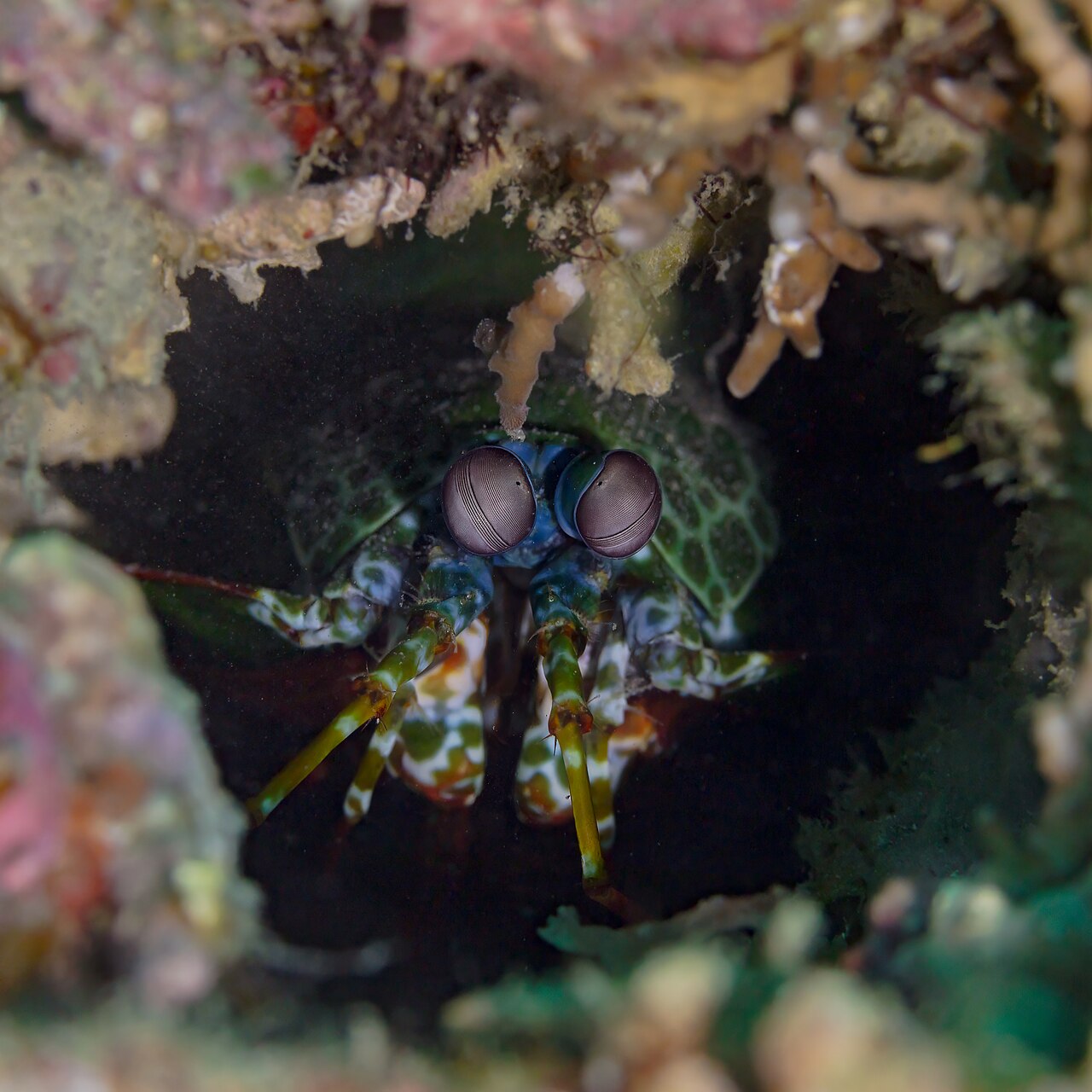
Humans have three kinds of pigments in the eye cells that let us see color. The mantis shrimp has about 30. Researchers from the University of Liège in Belgium and Humboldt University in Berlin have now studied these pigments one by one for the first time. They found that some respond to red light that very few animals can see. The result was published in Science Advances and could be useful in optogenetics, a method that uses light to control cells.
Vision depends on proteins called opsins, which catch light and turn it into an electrical message for the brain. Together with a small molecule called retinal, which comes from vitamin A, opsins make the visual pigments in the eye. In many animals without a backbone, such as insects and crustaceans, the eye has several parts, and each can specialize in ultraviolet, blue or green light. The mantis shrimp goes further. Its eye is split into two halves by a central strip called the median band, which handles color vision and has an unusual number of opsins.
It has been hard to study why this animal sees so well, since all the proteins live together in the eye and are very difficult to make in the lab. A team of scientists solved this with a lab method created by Marjorie Liénard, along with the expertise of Peter Hegemann's laboratory in Berlin and help from several universities. They measured how the 17 visual opsins of the median band respond to light. Twelve were standard green opsins, like our own green pigment. Three were infrared opsins, and two of those were red-blue "bistable" opsins at the edge between visible and infrared light. The other two were blue-orange bistable opsins.
Four of the pigments are bistable, which means they can switch between two steady states when they take in light, without needing a cell process to reset them. Two are turned on by red light and off by blue light. The other two work the other way around: blue turns them on and orange turns them off. Together with colored filters in the eye, the pigments let the shrimp see light up to 687 nanometers.
More in Science

Ancient Japanese Populations Changed Differently After a Huge Volcanic Eruption
A new study led by Lund University finds that people in prehistoric Japan were affected in different ways after a volcano erupted about 7,300 years ago.

A Study of 38,467 Songs Finds Lyrics Have Become Less Emotional
Michigan State University researchers looked at songs from 230 artists between 1947 and 2024.

A New Undersea Cable Called Petal Will Carry Huge Amounts of Internet Data
The 4,300-mile cable between the U.S. and France is planned to start working in 2029.